Showing posts with label Bonnie Adair. Show all posts

Sunday, September 14, 2008

I had a video clinic with, Bonnie Adair, the head coach of the LMU Women's swim team!

Swimming is about symmetry and execution. When I saw my stroke today underwater, I realized that every bad habit I have as a swimmer was generally a solution to some other problem I was having.

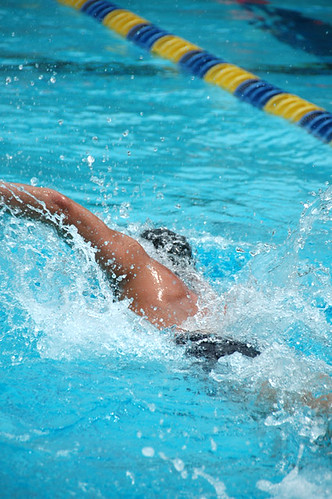
For instance my left hand enters the water thumb-side, downward, in front of my head. I then point my hand outward so as to scull it over to a line in front of shoulder so I won't tweak my shoulder joint. The sculling ultimately slows down my turnover an wastes time. Why not just land the hand directly in front of the shoulder and start my catch immediately? (Duh!) I was given a good drill to fix that. (Water polo swimming, with the head looking straight ahead only.)

Another problem I have is that I don't hold my streamline position long enough during my dive or off the walls and I am too relaxed. I should be more of a "toned" unit compressing as much space as I can. I also lift my head to soon like "Superman" so as to float to the top quicker. (My dive needs work too.)

Here is something Glenn Mills would like to know, Kara Lynn Joyce's DVD was referenced in regards to rotation, catch and turns. Though my flips are real good, I could lose "mad time" off the walls if I tone it up a bit and compress more. As to what these errors were "solving," the problem my "floppiness" quasi-solved was that I was using my walls as a rest period instead of a power opportunity to do some real work.

I feel if I can implement all these tweaks into my stroke by Spring, My times should madly improved. Perhaps even a silver-painted tin medal at SPMA Regionals.

Sunday, March 02, 2008

Ceasar Cielo uses a straight arm recovery!


UPDATE: Reedit number three of this of this post with better references especially since Glen Mills says it better than I do in the third and fourth paragraphs and I also included an article he wrote dedicatd to the subject. Also, I quote the Canuck Swimmer way better:

Technique should not be a religious conviction but rather a evolving process validated by the clock.

The Total Immersion school refrains from a straight arm recovery and in my opinion they should adjust and be less dogmatic. Note Ceasar Cielo's straight arm recovery. So, now we have Stefan Nystrand, Eamon Sulivan and Cesar Cielo swimming and winning with a straight arm recovery. This is more evidence that swim technique should be adopted to one's body type and abilities rather than compromising one's ability or strengths to fit into a specific technique or form.

Glen Mills says: "... My opinion is simply that they should each be tried, cause ya never know which is going to be right for the swimmer until each has been somewhat explored.

You can tell pretty quickly with most swimmers, but with some it's going to take more work. From a physiological, and biomechanical point of view, since no two people are created the same, I personally don't think we can say one has an advantage over the other. Of course, until you apply it to one person... then we're back to the previous statement, search, experiment, explore, then determine. ..." [Link]

Here is an article by Glenn Mills dedicated completely to the subject of arm recovery: "...Everyone will have a slightly different recovery, based on physiology, age, gender, strength, fitness level, flexibility, goal of swim, etc. (you can see there are a lot of variables). Yet with all the variations and suggestions about the proper recovery, everyone is pretty much agreed that the GOAL is to get the hand to the point at which it’s going to begin the next stroke. Generally, you want to achieve full extension out front, enough rotation to hook your body into the stroke, and (hopefully) not too many air bubbles UNDER the hand (even that’s open to debate). ..." [Link]

The Canuckswimmer stated on his blog: "...A column written by Olympic gold medalist and physician Gary Hall Sr. goes a step further and speculates this technique may be a major contributing factor in their success by virtue of its ability to utilize centrifugal force to speed up the recovery stroke.

Clay Evans said that exceptionally strong upper bodies of the swimmers in question all have the ability to use their arms as effective fulcrums leveraging more water like a kayak paddle.

My take is that the freestyle stroke becomes a physically simpler stroke to execute with less "wiggle" and "fewer moving parts" since a straight arm recovery forces the hips and shoulders to rotate in unison thereby leveraging the body into the proper hydro-dynamic position setting up a better streamline scenario for a powerful catch.

Clay Evans, Lyle Nellie and Erik Hochstein told me that during a sprint you reach your maximum speed by the 4th or 5th stroke and that is when you relax and just maintain momentum. Erik, Clay and Lyle called it "easy speed." So does Bonnie Adair. Hence, the simpler the execution, the easier it is to relax and maintain momentum and that is the crux of all swimming: maintaining momentum.

I am not a great swimmer, I may even be the slowest blogger but I love swimming and I love trying to improve my swimming in every workout. I do that by listening, practicing and refining. This straight arm rcovery has me intrigued!

Tuesday, May 01, 2007

I did a sprint workout last sunday and I learned a cool start drill

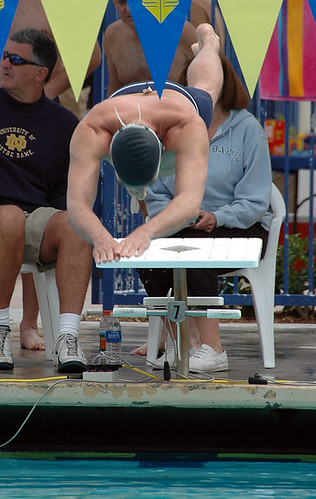
I have fast reflexes but when I dive into the water my body resembles a starfish more so than a tight streamline. (That is me to the right.)

Bonnie Adair, the head coach of LMU Women's swimming, had me do a start drill so as to improve my streamline. She had me dive into the water with a pull buoy between my legs and the object was not to let it fall out. If you do it right you will maintain a tight streamline with your legs, pressed together and hydrodynamic. If you do it wrong, and you are a man... Well; I will phrase it this way, it could bump into your $1.50 if it flies out. Ultimately you are rewarded if you streamline and unrewarded if you are not.

Wednesday, April 04, 2007

Bonnie and Clay will be coaching at VNSO tonight

From the email: "... SCAQ founders Bonnie Adair and Clay Evans will both be coaching the VNSO workouts tomorrow night and conducting a stroke technique workout. This is short notice, but it will be an intensive session of stroke work and how to get started swimming. This is perfect for those of you in the San Fernando Valley area and can't make the mid week workouts and clinics. This is open to all swimmers that are not on SCAQ! ..."

Here is an article about SCAQ in Competitor Magazine: [Link]

Monday, March 12, 2007

Go Swim has an article on flipturns

It's a bit rudimentary but useful. From the article:

"...The ENTIRE point of this drill, or focus, is to create more FLOW on your flip turns -- whether for freestyle or backstroke. The goal is to eliminate ANY delay between when your feet are ready to push off... and when your hands are ready to streamline. The two things should happen at the same time... and the hands should get into position with no hesitation and with no jerky or sudden movements. ..." Here is the article: [Link]

Personally, I think it is a worthwhile investment to do a " "Freestyle Technique with Turns" clinic with Bonnie at the LMU pool so Bonnie, Clay or another coach can look at your turn and coach to your abilities. That's what I did and I learned about not breathing off the walls, creating a more symmetrical flip, and better streamline position.

However, if you're cheap, I think this article is marginally decent but drills are best learned when coached. Learning something as fine tuned as a flip turn from a website is like trying to learn Tai Chi from a cheesy pamphlet you bought in China Town.

Friday, March 09, 2007

Race Training For Swimming Sprints from Timed Finals


Timed Finals posted a great article on swim sprints. A reader wrote in with a question and one of the answers given was rather clever:
  • Colin M. answers: For what it’s worth, in swimming 50s with my TI stroke, I focus on getting more out of each pull, instead of turning the arms over faster. I make sure I complete the entire stroke, and also focus on the front quadrant swimming part. If I want to increase my speed, I do so by letting my hips set the pace. Since focusing on this TI stuff, I actually swim faster by taking fewer strokes, and making those count.
The article can be read here: [link]

Don't forget to RSVP for the SCAQ lactic workouts with Bonnie and Erik at LMU this weekend.

Wednesday, January 03, 2007

"Healing Swimmer's Shoulder by Staying in the Water"

"Healing Swimmer's Shoulder by Staying in the Water"
-- Bonnie Adair

Bonnie Adair is the head Coach of the LMU Women's swim team and co-founder of Southern California Aquatics. In just three years as head coach, Bonnie has turned the LMU program into a contender for the Pacific Coast Swimming Conference Championship. The LMU Lions finished a program-best third in the conference in 2005 and set 16 of 19 school records in a history-making season. LMU earned its first two conference event titles in 2005, winning both the 200 medley relay and the 100 backstroke. [LMU Swimming

During her own 13-year swimming career, she set 35 National Age Group records including a 50m freestyle record that stood for 29 years.

Many swimmers and triathletes of all levels have succombed to the pain of "swimmer's shoulder," an impingement syndrome caused by repetitive shoulder rotations. A typical Masters or fitness swimmer swimming three 1-hour workouts each week will do between 10,000-11,000 rotations compared to a professional tennis player who will do approximately 1,000 rotations.

The standard Rx: ice the involved area, take an anti-inflamitory medication and give the shoulder a rest. In short: stay out of the water! This may be good advice for that occasional flare up of shoulder pain caused by extra activity or heavy lifting, but it is not the desired treatment plan for those with chronic shoulder pain who do not wish to interrupt their training regimen by skipping workouts each time that nagging shoulder ache returns. Thus, we designed this workout to allow you to continue your training while correcting poor stroke mechanics and building strength in the vulnerable area.

In our program at SCAQ, we train over 1,500 swimmers each year and are confronted almost daily with complaints of shoulder pain from swimmers of every level - ranging from new fitness swimmers and first time triathletes to aging competitive swimmers still seeking that personal best.

We employ a 3-step approach to eliminating shoulder problems:
(1) Correct technique: If you have chronic shoulder problems, chances are you have a flawed stroke which causes excess pressure to be placed on your shoulder structures. By making a few simple stroke adjustments, we find that we can quickly eliminate shoulder pain in 90% of our swimmers that are having repeated "flare-ups. If you are one of these, ask your coach to look at your stroke or, better yet, sign up for a video clinic if one is available to you.


(2) Strengthen: We strongly recommend that all swimmers, not just those with shoulder problems, incorporate a series of dryland shoulder strengthening exercises into their weekly training schedule (3-4 times/week).


(3) Relax: learn to relax while swimming.
However by staying in the water and slightly modifying your standard workout, you also can strengthen this vulnerable area, something not being done when you are continuously "giving it a rest" by skipping weeks of workouts waiting for the pain to subside. And the good news is that the modified workout we recommend actually accelerates your heart rate and provides a great conditioning workout. So here it is!


Warm-up: Easy 400 - Alternate breathe to even out stroke. Relax.
Warm-up #2: 4 X 100 freestyle increasing effort each 100 but only to 80% on 4th 100.
Warm-up #3: 4 X 50 - 3 on a short rest interval providing 5-10 sec. rest, the 4th 50 is easy. Repeat set 3 more times with 30 seconds rest in between each set for a total of 12 X 50. Stay between 80-85% effort. These are not sprints! [Total 1200 yards]


Main Set: 6 X 200. If you are having a "bad shoulder day" we recommend that you use a short fin on this set and follow this pattern. #1: Do the first 150 yards using a "catch-up" or "touch-stroke" to stretch out and relax the arm cycle. Put your kick into overdrive, which will increase your cardiovascular output. The last 50 is in your regular stroke cycle. #2: The first 100 is "catch-up" stroke, the second 100 regular cycle.#3: The first 50 is "catch-up," the remaining 150 regular cycle#4: Same as #1; #5: Same as #2; #6: Same as # 6
[1200 Total]


Kick set: 25 - 50 - 75 - 100 - 75 - 50 - 25. Repeat. [Total 600] Do not use kickboard as this will cause extra stress on your shoulders. Instead try kick on your side, alternating between right and left.


Sprint set:4 X 25 @ 30 sec. 2 breaths maximum each 25, loosen 25 4 X 25 @ 35 sec. 1 breath maximum each 25, loosen 25 4 X 24 @ 40 sec. no breath Until you are asymptomatic for 3 months, we recommend that you substitute breath control for "sprints." Stay below 90% effort but put your kick in overdrive to create.


Warm-down: 200 "catch-up" stretch out and relax.


ADDITIONAL TIPS:
Extend your warm up: At least 1/3 of your swimming workout should be in the "warm-up" phase. Gradually increase the effort, never exceeding 80% until you are well into the middle of your workout. You are still getting a good cardiovascular workout at 80% and are strengthening your upper body structures without tearing down the shoulder area by sprinting too soon. Save the 100% effort for another day when you have rehabilitated your shoulder to a point that it is pain free.


About pulling: we recommend that you don't pull in workout until you have been pain free for at least 3-months. Instead substitute "catch-up" stroke with a short fin when your coach gives pulling sets. Most importantly - stay away from paddles! If you must, use an undersized paddle which will still satisfy your "paddle addiction" without breaking down your vulnerable shoulder structures. Again, it is better to put the paddles away and use a short fin until you are asymptomatic for a minimum of 3 months.