


The Foro Italico: originally "... built between 1928 and 1938 as the Foro Mussolini under the design of Enrico Del Debbio and, later, Luigi Moretti. ..." It was modified for the 1960 Olympics with an outdoor pool and later remodeled again for the 2009 FINA World Championship which may perhaps be the most significant FINA World Championships ever held.
"... Inspired by the Roman forums of the imperial age; it's design is lauded as a pre-eminent masterpiece of Italian Fascist architecture instituted by Benito Mussolini. ..."
Photo Attribution: Posted to Flickr by antmoose and can be seen here [Link]


Yoyogi National Gymnasium Tokyo 1964: [The Complex] "...was designed by Kenzo Tange and built between 1961 and 1964 to house swimming and diving events in the 1964 Summer Olympics. The design inspired Frei Otto's arena designs for the 1972 Summer Olympics in Munich.
The arena holds 13,291 people (9,079 stand seats, 4,124 arena seats and 88 "royal box" seats) and is now primarily used for ice hockey and basketball.
In October 1997, the NHL opened its season at the arena with the Vancouver Canucks taking on the Mighty Ducks of Anaheim in two matches. The following season the San Jose Sharks played the Calgary Flames in two games also to open the 1998–99 NHL season.
Photo attribution: kanegen's photostream & Joe Jones' photostream
at Flickr.
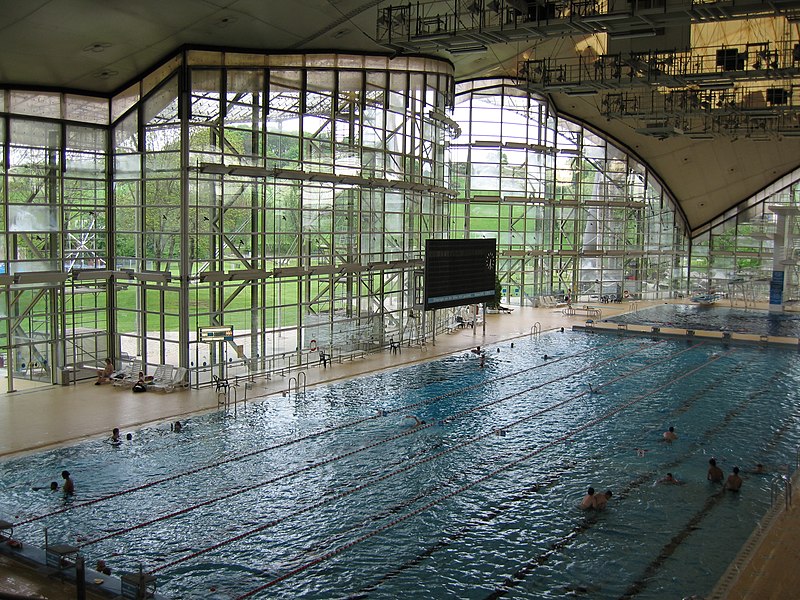

The Olympia Schwimmhalle: is an aquatics centre located in the Olympiapark in Munich, Germany. It hosted the Swimming, Diving, and Water Polo events at the 1972 Summer Olympics. At the 1972 Olympics, the stadium had a 9000-seat capacity which was reduced to 1,500 soon after. During the 1972 Olympics, the Olympic Records in all 29 Olympic swimming events were broken as well as the World Records in 20 events. -- [citation needed - Wikipedia]
The Schwimmhalle is unique for its roof construction which is a lightweight stressed-skin structure. This curved structure bears loads through tension only, not compression. The double curvature in the roof design is what provides support which is further stablized through pretensioned guy wires.
Olympic Park built for the 1972 Olympics: "... The concept of a "green Olympic Games" was chosen, and so too was the orientation toward the ideals of democracy. Officials sought to integrate optimism toward the future with a positive attitude toward technology, and in so doing set aside memories of the past, such as the Olympic Games of 1936 in Berlin. -- Source Wikipedia


The Montreal Olympic Pool was constructed for the 1976 Summer Olympics as part of the Montreal Olympic Park. The olympic pool is part of the larger swimming centre, located in the base of the inclined tower. The centre has a spectator capacity of 3,012 seats.
At the 1976 Olympics, the venue hosted swimming, diving, and water polo. It had a capacity of 10,000 seats at the time (6,988 temporary seats were installed).
The building was designed by French architect Roger Taillibert, who also designed the Olympic Stadium and Olympic Village. -- [Source Wikipedia]
Photo source: TravelWebshots.com


Central Lenin Stadium it was called and it is an aquatics center that is part of the Luzhniki Sports Complex in Moscow, Russia. It was opened in 1957 and renovated in 1980. The 10,500-seat venue hosted Water Polo events at the 1980 Summer Olympics. It also hosted events of the 1973 Summer Universiade, 15th World Festival of Youth and Students, 1986 Goodwill Games, Spartakiads of the Peoples of the USSR and others. --[Source Wikipedia]
The center will be updated
Photo source: Arsengeodakov

Jamsil Indoor Swimming Pool is an aquatics venue located in Seoul, South Korea. It hosted the swimming, diving, and water polo events at the 1988 Summer Olympics.
Source: '자작' [Wikipedia]

The Athens Olympic Aquatic Centre is a complex at the Athens Olympic Sports Complex, consisting of two outdoor pools and one indoor pool, that was built for the 1991 Mediterranean Games. It was refurbished and expanded for the 2004 Summer Olympics. The larger of the outdoor pools, which seats 11,500 spectators, hosted swimming and water polo events. The smaller pool, which hosted synchronized swimming, sat 5,300 fans. The indoor pool, which hosted the diving events, sat 6,200 observers.
The outdoor pool was the subject of significant controversy during the run-up to the Olympic games. A roof was planned that would have shielded the swimmers from the blazing Athens sun. This feature was later scrapped, leaving the athletes and most of the fans without shade during the events; however, during the course of the games, no athletes made major complaints regarding the facility, nor was there any mention of the lack of a roof affecting athletes' performances[citation needed] - in fact, many Olympic and world records were broken and/or set in this FINA-approved, world-class venue.
Photo of the Athens Olympic Aquatic Centre taken from the stands by Prisonblues
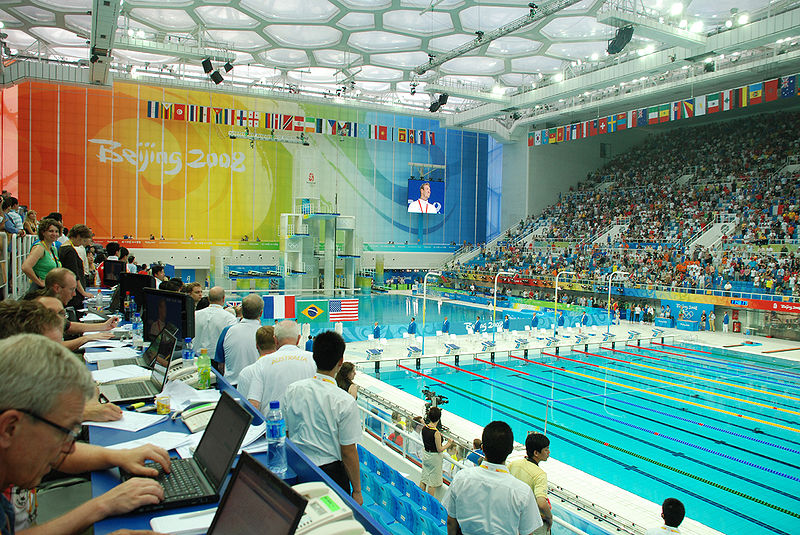

The Beijing Aquatics Center (Water Cube) hosted the Swimming, Diving and Synchronized Swimming events during the Olympics. Water Polo was originally planned to be hosted in the venue but was moved to the Ying Tung Natatorium.
Many people believe Water Cube to be the fastest Olympic pool[10] in the world. It is 1 meter deeper than most Olympic pools. Up to a certain limit, beyond which swimmers will lose their sense of vision, deeper pools allow the waves to dissipate down to the bottom, leading to less water disturbance to the swimmers. The pool also has perforated gutters on both sides to absorb the waves.
With the popularity of the newly introduced faster Speedo LZR Racer swim suit, the Aquatics Center saw 25 world records broken in the Beijing Olympics[3].
Since June 20, 2009 the Watercube has been open to the public on certain days of the week. It is also used for sound and light shows and during the summer of 2009 was turned into a ballet theater for a production of Swan Lake. The building's popularity has spawned many copycat structures throughout China.
Indoor photo attribution: Jmex60 from Wikipedia Creative Commons. Exterior photo attribution Charlie fong from Wikipedia Creative Commons
I am going to add more to this post.
The idea that the USOC supports a "frugal" Olympics is a clear and absolute indication that it views them solely as a profit opportunity. The Olympics should transcend that idea
I will finish this post soon and I will include more glorious stadiums that pay homage to the Olympic ideal.

